Two-wheelers dominated the Electric Vehicle Battery Swapping Market with 84.37% share in 2025, reflecting massive adoption in Asian urban delivery fleets.
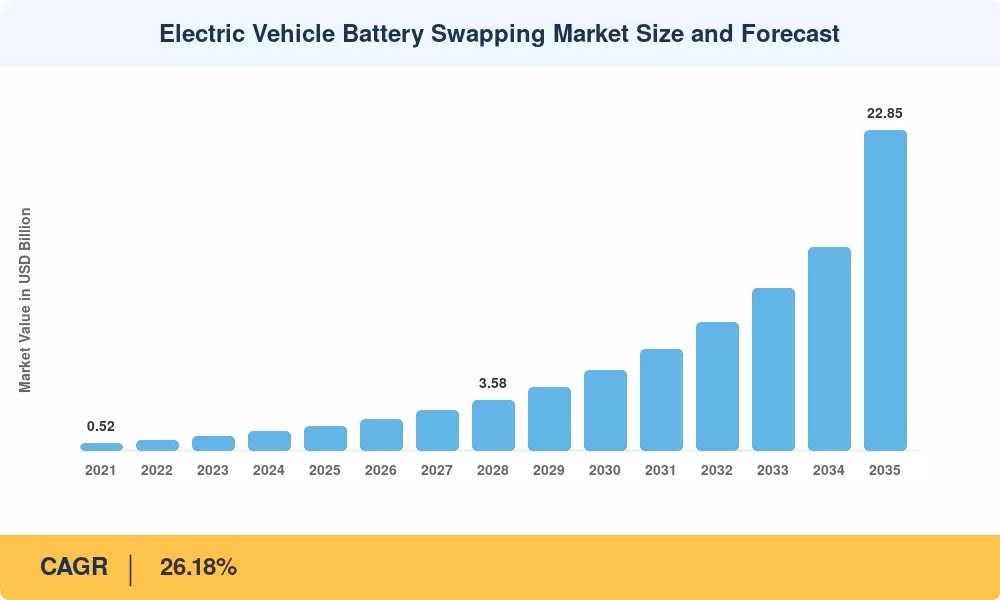
NEW YORK, NY, UNITED STATES, July 24, 2026 /EINPresswire.com/ — The Electric Vehicle Battery Swapping Market was valued at USD 1.73 billion in 2025 and is projected to reach USD 2.22 billion in 2026 before expanding to USD 22.85 billion by 2035, registering a CAGR of 26.18% during the forecast period (2026–2035).
Market Overview
Electric vehicle battery industry swapping is an innovative refueling model where a depleted battery is removed and instantaneously replaced with a fully charged one at a dedicated swapping station . The entire process, often automated, can be completed in just a few minutes, closely mimicking the speed and convenience of refueling a conventional gasoline-powered car . This technology eliminates long wait times associated with traditional EV charging, addressing two of the biggest hurdles to EV adoption: range anxiety and charging inconvenience . Battery swapping systems rely on standardized removable battery packs designed for compact EV platforms, enabling quick exchange and continuous vehicle operation . Key business models include Battery-as-a-Service (BaaS), subscription frameworks, and pay-per-use models .
Growth Drivers
The rapid expansion of electric vehicle adoption worldwide is the primary driver of the battery swapping market . Governments are introducing regulatory incentives, emission targets, and subsidy programs to promote electric mobility, encouraging investments in EV infrastructure, including battery swapping networks . Battery swapping is particularly valuable for high-mileage users and commercial fleet operators such as taxis, ride-sharing services, and delivery vehicles, for whom vehicle downtime equals lost revenue .
Government support through subsidies, policy frameworks, and initiatives to standardize battery technology is crucial in fostering the development and deployment of swapping infrastructure . China leads with subsidies for battery swapping infrastructure, while India’s policy frameworks like the FAME scheme promote adoption . The emergence of Battery-as-a-Service business models is also supporting market growth, reducing the upfront cost of EV ownership and improving affordability .
Industry Trends & Technological Developments
The industry is witnessing transformative trends driven by technological advancements, regulatory support, and shifts in consumer behavior. Efforts to standardize battery formats across different manufacturers are gaining momentum, crucial for creating a seamless battery swapping experience . Innovations in battery management systems and cloud-based connectivity ensure real-time monitoring of battery health, optimizing performance and longevity . Fast and automated swapping mechanisms, integrated with AI-driven robotics, reduce downtime and enhance operational efficiency .
Integration of battery swapping stations with renewable energy sources, such as solar and wind power, addresses sustainability aspects by ensuring energy for charging is derived from clean sources . The emergence of ultra-fast swapping stations is a significant trend aimed at reducing battery exchange times, making the technology more competitive with traditional charging methods .
Policy & Regulatory Influence
Government policies vary by country, with some providing incentives to encourage adoption of battery swapping technology . Countries such as China and India have specific regulations and financial incentives to promote development and use of battery swapping stations . In China, the government offers subsidies for battery swapping infrastructure, while India’s FAME scheme promotes adoption . Governments are also establishing standards and guidelines to ensure safety and interoperability of battery swapping systems . Recent U.S. tariff policies are prompting supply chain reassessment, with operators exploring localized assembly and diversified sourcing options .
Demand Outlook
The demand outlook remains exceptionally strong, driven by surging EV adoption and the need for fast, convenient energy replenishment solutions . Battery swapping infrastructure is gaining traction as governments and industry stakeholders aim to accelerate EV adoption while addressing range anxiety and charging limitations . The concept is particularly relevant for commercial fleets, ride-hailing services, and last-mile logistics operators where operational efficiency is essential . The investment gap in EV charging infrastructure presents a significant opportunity for battery swapping as a scalable and economical alternative to traditional charging stations .
Get Free Sample Report for Detailed Market Insights:
https://www.marketresearchfuture.com/sample_request/22888
Market Segmentation
By Station Type
Manual Swapping Stations: Hold a prominent market share, particularly for 2- and 3-wheelers, due to cost-effectiveness and ease of implementation . Companies like Gogoro, Sun Mobility, and Battery Smart are key players in this space. Automated Swapping Stations: Gaining traction with advanced robotics reducing human intervention and improving operational efficiency . Companies like NIO and Ample lead in automated solutions .
By Service Model
Subscription Model: Customers lease batteries based on requirements and business needs, offering cost savings, flexibility, and appeal among fleet operators . The separation of battery ownership and vehicle access allows for centralized lifecycle management. Pay-Per-Use Model: Suitable for customers without predictable charging patterns, aligning with a flexible, on-demand approach . Encourages customer loyalty and provides convenience .
By Vehicle Type
Two-Wheelers: Dominant segment, particularly in Asia-Pacific, driven by adoption in urban mobility, delivery services, and shared transportation networks .
Three-Wheelers: Substantial share as fleet operators adopt swapping for public and last-mile transportation. Passenger Vehicles: Driven by advancements in swapping technology and aggressive expansion by providers like NIO and Ample. Commercial Vehicles: High-growth segment, supported by fleet operators in ride-hailing and logistics .
You can buy this market report at:
https://www.marketresearchfuture.com/checkout?currency=one_user-USD&report_id=22888
Regional Analysis
Asia-Pacific
Asia-Pacific dominates the global market, propelled by large-scale adoption in China, India, Indonesia, and Taiwan, strong government incentives, and rapid urbanization . China leads globally with companies like NIO and BAIC expanding swapping networks significantly, supported by government subsidies . India is witnessing rapid growth with companies like Gogoro, Sun Mobility, Battery Smart, and RACEnergy building extensive networks . The region’s dense cities, heavy last-mile demand, and limited public charging infrastructure make battery swapping a practical alternative for quick energy replenishment .
North America
North America holds a significant market share, driven by increasing EV adoption, particularly in commercial and fleet sectors . Companies like Ample lead expansion with modular, autonomous swapping stations catering to ride-hailing, last-mile delivery, and shared mobility services . Strong policy support and incentives promoting EV adoption, along with partnerships between swapping providers and automakers, are strengthening the ecosystem . In November 2024, Ample announced a USD 25 million investment from Mitsubishi Corporation to expand its battery-swapping business .
Europe
Europe is gradually adopting battery swapping with a focus on commercial applications . Companies like Tank & Rast are piloting battery swapping stations for electric trucks to enhance long-distance logistics efficiency . The strong emphasis on sustainability and environmental regulations drives research into swapping solutions integrated with renewable energy sources and advanced grid systems . Strict government regulations aimed at reducing pollution and improving transportation efficiency are expected to expand the region’s market .
Rest of the World
Latin America and the Middle East & Africa represent emerging markets with early-stage initiatives tied to broader clean mobility goals . Latin America is gradually entering the EV market, with battery swapping gaining traction in countries like Brazil and Mexico . The Middle East and Africa show potential for growth, with countries like the UAE investing in EV infrastructure .
Competitive Landscape / Key Players
The Electric Vehicle Battery Swapping Market is dominated by a mix of established EV manufacturers, specialized swapping providers, and regional players .
Key Companies
NIO (China): A leading premium smart EV manufacturer with a signature Power Swap network enabling rapid battery replacement in minutes. Strategically leverages a Battery-as-a-Service (BaaS) model and is aggressively expanding in China and Europe .
Gogoro (Taiwan): Global technology leader in battery swapping ecosystems for light electric two-wheelers. Operates an expansive network of GoStations and focuses on international expansion, particularly in India and Southeast Asia .
Ample (US): Tackles charging challenges with modular battery swapping technology. Fully automated, small-footprint stations can swap batteries in under ten minutes. Focuses heavily on commercial and ride-hailing fleets .
Sun Mobility (India): Building a network of interoperable, modular swapping stations across India, focusing on fleets including e-rickshaws, cargo loaders, and delivery scooters .
Contemporary Amperex Technology Co., Limited (CATL) (China): Major battery manufacturer involved in the swapping ecosystem .
Strategic Developments
Key players are expanding portfolios through investments in innovative technologies, infrastructure enhancement, and strategic partnerships . Partnerships between automakers, technology firms, and energy providers facilitate development and deployment of swapping infrastructure . Companies are focusing on standardizing battery formats and ensuring interoperability . Recent developments include NIO’s expansion of Power Swap Station networks across China and Europe, and Ample’s strategic collaboration with Mitsubishi Corporation .
Latest Industry News & Developments
Gogoro Partners with Maharashtra Government: Gogoro partnered with Belrise Industries and the Maharashtra Government to build an EV battery-swapping ecosystem and smart energy hubs worth $2.5 billion in India . The company’s network already supports over 400,000 daily swaps through more than 12,000 GoStations at 2,600 locations .
India’s Battery Swapping Ecosystem Expands Rapidly: Sun Mobility operates over 600 stations across Delhi, Bengaluru, and Pune, while Battery Smart has expanded to over 1,000 stations across multiple states serving electric auto-rickshaw drivers and commercial EV users . India’s high-density cities and heavy last-mile demand are driving this expansion .
Ample Secures USD 25 Million Investment: In November 2024, Ample announced a USD 25 million investment from Mitsubishi Corporation to support expansion of its battery-swapping business . The company’s technology enables rapid, fully-automated battery exchanges in minutes, addressing range anxiety and reducing downtime for fleet operators .
Market Challenges & Opportunities
Key Restraints
Lack of Standardization: The most critical obstacle is the absence of battery standardization across manufacturers; a swappable battery from one brand will not fit in another . Variations in size, chemistry, and architecture make creating universal swapping systems difficult .
High Capital Expenditure: Significant investment required to establish dense networks of swapping stations and manage large battery inventories . Building automated stations requires robotics, battery storage systems, grid connections, and digital management platforms .
Operational Complexity: Managing battery inventory, ensuring battery health, and maintaining consistent performance across cycles require sophisticated monitoring systems . Consumer concerns about receiving older, degraded batteries must be resolved .
Competition from Fast Charging: Improvements in fast-charging technologies may make battery swapping less appealing . Grid limitations and costly capital still hinder fast-charging scalability .
Emerging Opportunities
Urban and Commercial Fleets: Battery swapping is increasingly adopted for urban transportation and commercial fleets, including delivery vehicles and public transport . Strategic placement of stations in high-density areas supports rapid turnaround and minimizes downtime .
Battery-as-a-Service Models: Emerging BaaS business models reduce EV upfront costs and improve affordability . Customers lease batteries based on requirements, offering flexibility and predictable costs .
Integration with Renewable Energy: Growing focus on integrating swapping stations with renewable energy sources to reduce carbon footprint and stabilize the energy grid .
Second-Life Battery Applications: Used EV batteries can be repurposed for stationary storage, creating additional revenue streams and sustainability benefits .
To explore more market insights, visit us at:
https://www.marketresearchfuture.com/reports/electric-vehicle-battery-swapping-market-22888
Final Market Summary
The Electric Vehicle Battery Swapping Market is positioned for exceptional growth, with projections indicating expansion from USD 1.73 billion in 2025 to USD 22.85 billion by 2035, at a robust CAGR of 26.18%. This extraordinary growth is driven by surging EV adoption, government support through subsidies and policy frameworks, and the operational advantages of swapping technology for urban mobility and commercial fleets. While challenges such as lack of standardization, high capital expenditure, and operational complexity persist, emerging opportunities in Battery-as-a-Service models, integration with renewable energy, and second-life battery applications offer significant potential for industry participants. The future market landscape will be defined by companies that successfully forge ecosystem partnerships, navigate regulatory alignment, and develop tech-forward infrastructure. With improvements in technology and greater standardization, battery swapping is poised to complement traditional charging networks, with Asia-Pacific set to dominate global growth .
More Related Reports from MRFR Library:
Screw compressor Market: https://www.marketresearchfuture.com/reports/screw-compressor-market-1812
Thermoelectric Generator Market: https://www.marketresearchfuture.com/reports/thermoelectric-generator-market-1845
Ductless HVAC System Market: https://www.marketresearchfuture.com/reports/ductless-hvac-system-market-1868
Non concentrating Solar Collector Market: https://www.marketresearchfuture.com/reports/non-concentrating-solar-collector-market-1877
Control Valve Market: https://www.marketresearchfuture.com/reports/control-valve-market-1940
Marine Engine Market: https://www.marketresearchfuture.com/reports/marine-engine-market-1988
Superconductor Wire Market: https://www.marketresearchfuture.com/reports/superconductor-wire-market-2068
HVAC Insulation Market: https://www.marketresearchfuture.com/reports/hvac-insulation-market-2072
Microgrid Market: https://www.marketresearchfuture.com/reports/microgrid-market-2215
Transformer Monitoring System Market: https://www.marketresearchfuture.com/reports/transformer-monitoring-system-market-2311
Larry Wilson
WantStats Research And Media Pvt. Ltd.
+ +1 855-661-4441
email us here
Visit us on social media:
LinkedIn
Facebook
YouTube
X
Legal Disclaimer:
EIN Presswire provides this news content “as is” without warranty of any kind. We do not accept any responsibility or liability
for the accuracy, content, images, videos, licenses, completeness, legality, or reliability of the information contained in this
article. If you have any complaints or copyright issues related to this article, kindly contact the author above.

Media gallery