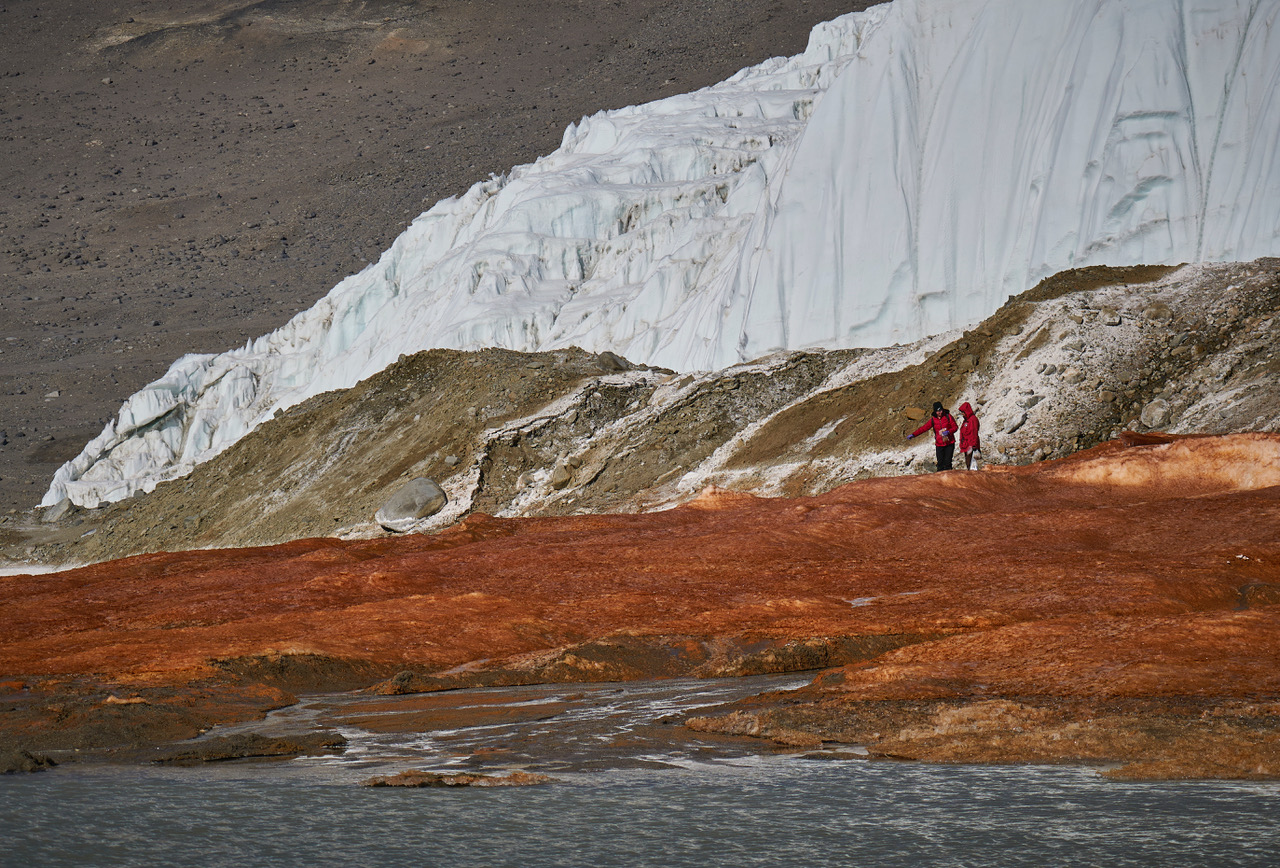
LA JOLLA, CA, UNITED STATES, August 3, 2026 /EINPresswire.com/ — Blood Falls has long been one of Antarctica’s strangest landmarks: a red-stained outflow that spills from the face of Taylor Glacier into the cold, dry landscape of the McMurdo Dry Valleys. The color comes from iron-rich brine that has been trapped beneath the glacier, isolated from the outside world and periodically released into the polar desert.
Now, a Nature Geoscience study suggests Blood Falls also preserves biological clues to Antarctica’s past. Researchers found molecular evidence of an active, marine-derived community of microscopic eukaryotes — organisms whose cells have a nucleus — near the Taylor Glacier terminus, pointing to ancient seawater that may have entered the valley during warmer periods before becoming sealed beneath ice.
The work was led by Angela Zoumplis, Ph.D., formerly a joint PhD student between the J. Craig Venter Institute (JCVI) and Scripps Institution of Oceanography at the University of California San Diego and now a postdoctoral researcher at Yale University and visiting scientist at JCVI. The senior author is Andrew E. Allen, Ph.D., a professor at JCVI and Scripps Oceanography.
“This is an environment that looks almost completely cut off from the ocean today,” Zoumplis said. “But when we looked at the molecular signatures of the organisms living in the red mud and sediment around Blood Falls, we saw a surprisingly strong marine signal. That tells us this place may be preserving traces of an older connection between the Dry Valleys and the sea.”
The McMurdo Dry Valleys are among Earth’s coldest, driest deserts and a natural laboratory for life at the edge of habitability. Earlier work found bacteria in Blood Falls brine with similarities to marine microbes. The new study extends that story to eukaryotes, a group that includes diatoms, dinoflagellates, ciliates, and other microscopic life.
Diatoms are single-celled algae with glass-like silica shells and are useful environmental storytellers because many groups are tied to specific habitats. Marine-associated diatoms and other eukaryotes were strongest in red mud and sediment influenced by Blood Falls discharge, not broadly across nearby streams, lakes, or wind-collected samples.
“We were not just asking whether marine organisms were present,” Zoumplis said. “We wanted to know whether they were part of a distinct community, whether they looked different from nearby freshwater communities, and whether there was evidence that they were active. The answer to all three was yes.”
The team analyzed 167 samples from the Taylor Glacier terminus, other Dry Valley habitats, wind-deposited material, and marine reference sites in McMurdo Sound. They used molecular sequencing and metatranscriptomics — a method that examines RNA — to identify organisms and test whether the community was active.
The strongest marine signal appeared near Blood Falls. Marine-associated diatoms made up more than 60%, and in some analyses about 80%, of the diatom community in those samples. Most Dry Valley freshwater sites were dominated by different diatoms associated with terrestrial or freshwater environments.
RNA data showed the organisms were not merely genetic leftovers. Researchers found active phototrophic eukaryotes — organisms able to use light for energy — with gene activity tied to photosynthesis, stress responses, cellular repair, and survival in salty conditions.
“That activity is what makes the finding especially exciting,” Zoumplis said. “We are not simply seeing genetic leftovers. We are seeing evidence of organisms responding to a harsh, changing environment — freezing, thawing, salt stress, iron exposure, and long periods of inactivity.”
The study also addresses how marine material ended up in inland polar desert environments. Marine diatom fossils and fragments have been found in several nonmarine Antarctic settings, stirring debate over whether they arrived through ancient marine incursions, wind transport, or both.
The findings do not rule out all wind transport, but modern wind alone appears unlikely to explain the Blood Falls pattern. Marine signatures were rare in wind-collected samples, while the Taylor Glacier terminus community showed both marine affinity and genetic distinctions from modern McMurdo Sound communities.
“These results point to persistence, not just delivery,” Allen said. “The molecular signatures we detected point to a localized community shaped by the unusual chemistry and history of Blood Falls. That gives us a biological window into past Antarctic ocean-ice-land connections.”
Blood Falls may provide a rare refuge. Its brine is rich in salts, iron, silica, and other materials and periodically mixes with glacial meltwater. Some organisms detected in the study form resting cells, cysts, or spores that can help them survive until conditions improve.
The finding does not mean Blood Falls contains an unchanged ancient ocean community. Instead, today’s community likely reflects marine organisms introduced during past periods of ocean influence, possible redistribution within the valley, limited modern transport, and strong selection by extreme conditions at the glacier terminus.
The study adds to evidence that Antarctica’s polar deserts host specialized microbial ecosystems that preserve information about environmental change. Understanding these communities may help scientists reconstruct past climate and ice-sheet dynamics and learn how life survives in isolated, salty, cold environments.
The study, “Molecular evidence for a relict marine community in an Antarctic Dry Valleys subglacial brine-fed system,” was published in Nature Geoscience. Collaborating institutions include the University of Colorado Boulder, Lund University, and the University of Tennessee, Knoxville.
Support came from National Science Foundation Grant OPP-1637708 to the McMurdo Dry Valleys Long Term Ecological Research program; NSF Antarctic Sciences Awards NSF-OPP-0732822 and NSF-OPP-1043671; NSF Ocean Sciences Awards NSF-OCE-1136477 and NSF-OCE-1756884; NSF-OPP-1643687; and Gordon and Betty Moore Foundation Grant GBMF3828.
About JCVI
The J. Craig Venter Institute (JCVI) is a not-for-profit research institute in Rockville, Maryland and La Jolla, California dedicated to the advancement of the science of genomics; the understanding of its implications for society; and communication of those results to the scientific community, the public, and policymakers. Founded by J. Craig Venter, Ph.D., JCVI is home to approximately 120 scientists and staff with expertise in synthetic biology, human and evolutionary biology, genetics, bioinformatics/informatics, information technology, high-throughput DNA sequencing, genomic and environmental policy research, and public education in science and science policy. JCVI is a 501(c)(3) organization. For additional information, please visit www.jcvi.org.
Matthew LaPointe
J. Craig Venter Institute
+1 301-795-7918
email us here
Visit us on social media:
LinkedIn
Bluesky
Instagram
Facebook
YouTube
Other
Legal Disclaimer:
EIN Presswire provides this news content “as is” without warranty of any kind. We do not accept any responsibility or liability
for the accuracy, content, images, videos, licenses, completeness, legality, or reliability of the information contained in this
article. If you have any complaints or copyright issues related to this article, kindly contact the author above.

Media gallery