Vadzo Imaging has validated Multi-Camera Synchronization on the Innova-678CRS using PTP Sync across standard Gigabit Ethernet infrastructure, confirming that an array of independent camera nodes can be locked to a single shared clock domain for volumetric capture, 3D reconstruction, stereo vision and multi angle industrial inspection workflows, with the Sony IMX678 STARVIS 2 sensor delivering 8MP 4K resolution, HDR imaging and low light NIR performance over an ONVIF compliant PoE interface.
IRVINE, CA / ACCESS Newswire / August 13, 2026 / Vadzo Imaging, a global provider of embedded vision and machine vision camera products, today announced the validation of Multi-Camera Synchronization through PTP Sync on the Innova-678CRS. The Innova-678CRS is an IMX678 GigE Camera built on the Sony STARVIS 2 IMX678 sensor, delivering 8.4MP 4K resolution over a Gigabit Ethernet interface with HDR support, ONVIF compliance, and Power over Ethernet. The validation confirms that multiple camera nodes sharing a single Ethernet segment can operate inside a common time domain, allowing OEM engineers and system integrators to build a synchronized multi-camera system without running dedicated trigger wiring between every node in the array.
Why Timing Accuracy Decides the Accuracy of a Multi-Node Vision System
A single camera vision system carries a simple timing model. The host requests a frame, the sensor exposes, and the resulting timestamp only has to remain consistent with itself. That assumption collapses the moment a second node joins. Two camera products on the same network each run a free-running local oscillator, and those oscillators drift relative to one another because of manufacturing tolerance, supply voltage variation, and junction temperature. 10 parts per million of relative drift accumulates to roughly 36 milliseconds of divergence across one hour of operation, which on a 4K sensor represents several full frames of misalignment between nodes meant to be observing one object at one instant.
Teams building volumetric capture rigs, stereo vision pipelines, and multi-angle inspection cells meet this failure in a frustrating way. Every individual stream looks correct. The defect surfaces downstream when the reconstruction engine triangulates a moving subject from frames captured at slightly different instants. Point clouds develop ghosting along motion boundaries. Structure from motion solvers fail to converge because the calibrated epipolar geometry no longer describes the actual capture instants.
The usual workarounds each carry a cost. Host-side software timestamping records the arrival time of a frame at the host and treats it as the capture time, folding operating system scheduling latency, network stack processing, driver buffer copies, and switch queuing into the measurement. Hardware trigger wiring solves the timing but scales poorly, because every node adds a cable run back to a central distribution point and long runs between separately grounded enclosures introduce ground loop risk.
How PTP Sync Establishes a Shared Clock Domain Across a Camera Network
PTP Sync refers to the IEEE 1588 Precision Time Protocol, a network protocol that distributes a single reference time across devices connected by a packet-switched network. Rather than distributing an electrical edge, PTP distributes a value that every device uses to correct its own clock. Clock selection is automatic. Each participant advertises the quality of its time source, and the best master clock algorithm elects a grandmaster. The grandmaster then issues periodic Sync messages carrying its transmission time, and each slave records the reception time and computes the raw difference between the two values.
That raw difference mixes two terms. One is the genuine offset between the clocks. The other is propagation delay through cabling and switches. Separating them is the core of the protocol. Each slave issues a Delay Request message toward the grandmaster and records its transmission time, and the grandmaster returns the reception time in a Delay Response message. Assuming a symmetric path, half the round-trip time is the mean path delay, and subtracting it isolates the true clock offset.
Accuracy depends on where those timestamps are captured. Timestamps taken in application software carry the full operating system jitter described above, while timestamps captured in hardware at the network interface remove the software stack from the measurement entirely. Switch behavior matters equally. A transparent clock switch measures how long each PTP packet sat in its own queues and writes that residence time into a correction field, while an ordinary switch adds queuing delay the protocol cannot see.
Once every node shares a common time base, triggering changes character. Acquisition no longer starts when a message arrives. It starts at an absolute timestamp agreed in advance, so delivery variability stops mattering because the command only has to arrive before the scheduled moment. Synchronization becomes a scheduling problem. A shared clock also allows the transmission window of each node to be offset so that 4K bursts interleave rather than collide in switch buffers.
Sensor and Camera Overview
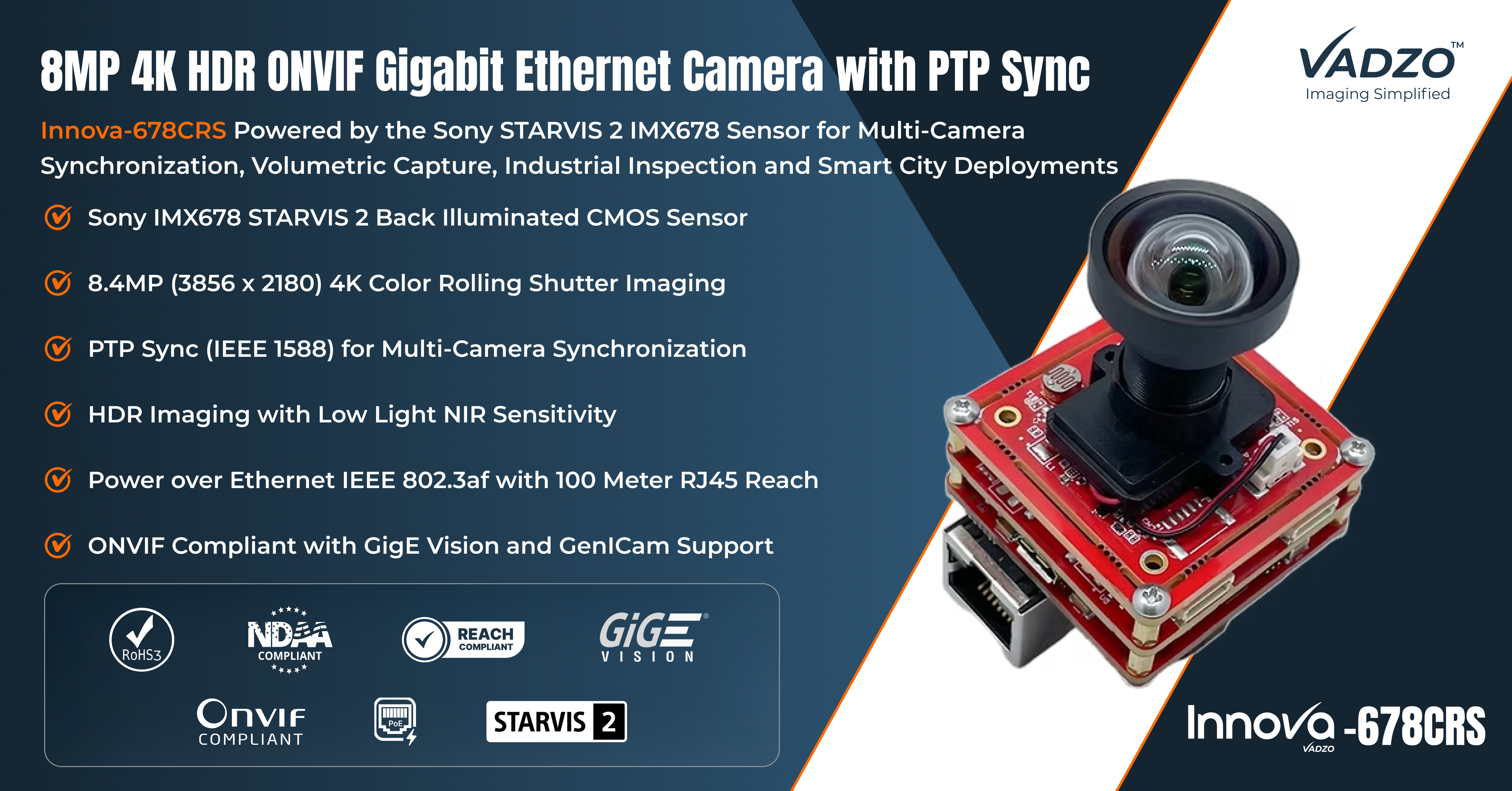
The Innova-678CRS is a 4K HDR GigE Camera built on the Sony IMX678 STARVIS 2 image sensor. It delivers 8.4MP resolution at 3856 x 2180 over a Gigabit Ethernet interface operating at 100/1000Base-T. STARVIS 2 is Sony’s current back-illuminated pixel generation. The architecture places the photodiode layer on the light-receiving side of the die, raising photon collection efficiency compared with front-illuminated designs of the same physical size. The practical results are a higher signal-to-noise ratio at low illuminance, cleaner shadow detail in high-contrast frames, and stronger near-infrared response. As a color rolling shutter sensor, the IMX678 reads pixel rows sequentially, an approach well matched to fixed installations and wide-area monitoring, giving the Innova-678CRS its identity as an IMX678 Rolling Shutter GigE Camera and an IMX678 Color GigE Camera. In Vadzo’s broader lineup, this sensor and interface pairing is also known as the Sony Starvis2 GigE Camera and, at full resolution, the Sony Starvis2 4K GigE Camera, with the combined 4K and HDR feature set forming the Sony Starvis2 4K HDR GigE Camera configuration.
On the camera side, the Innova-678CRS operates as an ONVIF-compliant node with GigE Vision and GenICam compatibility, so it drops into existing video management software and machine vision frameworks without proprietary middleware. Power arrives over the same cable as image data through Power over Ethernet compliant with IEEE 802.3af, and the RJ45 interface supports runs of up to 100 meters. As a GPIO GigE Camera, the Innova-678CRS provides hardware trigger input and strobe output for local timing relationships with a PLC, a robot controller, or an illumination source. PTP Sync operates alongside GPIO rather than replacing it, giving integrators a network-level time reference for the array and a local electrical trigger for equipment with no network presence. Optics use the S-Mount standard. As an IMX678 Gigabit Ethernet Camera and a Sony Starvis2 Gigabit Ethernet Camera, the Innova-678CRS carries the same PoE, ONVIF, and GPIO feature set across every one of these configurations.
Key specs: 8.4MP (3856 x 2180) 4K | Sony STARVIS 2 IMX678 | Rolling Shutter | Color | HDR | NIR Sensitivity | Gigabit Ethernet (100/1000Base-T) | GigE Vision and GenICam Compatible | PTP Sync (IEEE 1588) | GPIO Trigger and Strobe | PoE IEEE 802.3af | RJ45 100 m Reach | ONVIF Compliant | S-Mount (M12 Standard) with Auto Switch IR-Cut Filter | Operating Temperature of -30°C to +85°C | Windows, Linux and Android
Key Capabilities of the Sony IMX678 4K HDR Gigabit Ethernet Camera
Multi-Camera Synchronization Over Standard Network Infrastructure: The validated PTP Sync implementation allows every Innova-678CRS in an installation to discipline its local clock against an elected grandmaster and schedule acquisition against absolute time. The operational effect is that the network cabling already required for image transport also carries the timing reference. A synchronized multi-camera system can be extended by adding a node to the switch rather than by redesigning a trigger harness. Because the mechanism is standards-based, the same clock domain can include motion controllers and industrial Ethernet devices that already speak IEEE 1588, so image data and process data land on one timeline. This is what makes a Gigabit Ethernet camera module architecture practical for distributed installations. In this configuration, the Innova-678CRS functions as a Multi-Camera Synchronization GigE Camera, and every node in the array operates as a PTP Sync GigE Camera and a PTP Synchronized Camera on the same Ethernet segment.
Sony IMX678 Image Sensor and 4K Resolution: Resolution determines how many pixels fall across the smallest feature an application has to resolve, and that budget is consumed quickly in wide-area work. A 4K sensor covering a four-lane roadway allocates roughly twice the horizontal sampling of a 1080p sensor at the same field of view. In a synchronized array, that sampling density carries additional weight because triangulation error scales with the angular uncertainty of each observed feature. Higher resolution at every node tightens the geometry reconstructed by the array as a whole, which is why an 8MP GigE Camera is specified for 3D reconstruction and volumetric capture work. With HDR enabled, this same sensor becomes an 8MP 4K HDR GigE Camera suited to high-contrast, wide-area scenes. This sensor is also available as an 8MP Gigabit Ethernet Camera and a Sony Starvis2 Gigabit Ethernet Camera for teams standardizing on a single platform.
HDR Imaging Across High Contrast Scenes: Real deployments rarely present evenly illuminated scenes. A loading dock holds a sunlit apron and a shaded interior in one frame, and an intersection at night mixes headlight glare with unlit pedestrian areas. A standard exposure forces a choice between clipped highlights and crushed shadows, and both outcomes destroy the feature information downstream inference depends on. The high dynamic range capability of the IMX678 HDR GigE Camera preserves detail across a far wider luminance span within the delivered frame. This configuration is offered as both an IMX678 4K HDR GigE Camera and an 8MP HDR GigE Camera within Vadzo’s Innova series. In a synchronized array, the benefit compounds, because nodes viewing one subject from different angles face different lighting, and consistent exposure across nodes is what allows feature matching between views. Vadzo covers this class across its 4K HDR camera offering.
Low Light and NIR Performance: Low light capability follows from sensor architecture rather than from a processing setting. The back-illuminated STARVIS 2 pixel collects more of the available photon flux before any gain is applied, so the signal reaching the analog front end is stronger, and the noise floor of the delivered image is lower at the same illuminance. The same architecture extends useful quantum efficiency into the near-infrared band, allowing a Low Light GigE Camera node to operate under 850 nm or 940 nm illumination that remains invisible to occupants and passing drivers, a hard requirement in perimeter security, overnight traffic monitoring, and patient care. As a NIR GigE Camera, the Innova-678CRS extends this sensitivity without requiring additional infrared illumination hardware at the mounting position. Vadzo publishes a technical explanation of NIR imaging covering the wavelength considerations involved.
Gigabit Ethernet, Power over Ethernet and ONVIF Integration: The Gigabit Ethernet interface supplies up to 1000 Mbps of transport with deterministic delivery, long cable reach and native support for multiple nodes through standard managed switches, so the fabric scales by adding switch ports rather than host controllers. As a PoE Camera, the Innova-678CRS removes the local power supply at each mounting position through Power over Ethernet compliant with IEEE 802.3af, often the dominant installation cost on poles and gantries. Full ONVIF compliance places the same device inside the security ecosystem, so a single 4K Gigabit Ethernet camera node can serve a machine vision pipeline and a video management system at once. For bandwidth-constrained links, the relationship between resolution, bit rate, and image quality is covered in Vadzo’s guide to H.264 video compression. Whether deployed as a Rolling Shutter Gigabit Ethernet Camera or a Color Gigabit Ethernet Camera, the Innova-678CRS keeps this same PoE and ONVIF behavior across both configurations.
Product Specifications
|
Parameter
|
Specification
|
|
Camera Model
|
Innova-678CRS
|
|
Image Sensor
|
Sony IMX678 STARVIS 2 CMOS
|
|
Sensor Technology
|
Back Illuminated STARVIS 2 Pixel Architecture
|
|
Resolution
|
8.4MP (3856 x 2180) 4K
|
|
Shutter Type
|
Rolling Shutter
|
|
Color Mode
|
Color
|
|
HDR
|
Supported
|
|
NIR Sensitivity
|
Supported
|
|
Interface
|
Gigabit Ethernet (100/1000Base-T)
|
|
Synchronization
|
PTP Sync (IEEE 1588 Precision Time Protocol) and GPIO Trigger
|
|
Power
|
Power over Ethernet IEEE 802.3af
|
|
Cable Reach
|
Up to 100 Meters over RJ45
|
|
Compliance
|
ONVIF Compliant
|
|
Optics
|
S-Mount (M12 Standard) with Auto Switch IR-Cut Filter
|
|
Operating Temperature
|
-30°C to +85°C
|
|
Platform Support
|
Windows, Linux and Android
|
“Synchronization is where most multi-node vision projects quietly lose accuracy. Teams get the optics right, and the exposure right, then find their reconstruction is soft because two nodes were never actually looking at the same instant. Validating PTP Sync on the Innova-678CRS means our customers get a shared clock domain over the network they were already installing, and they get it alongside 4K resolution, HDR, and the low-light NIR behavior that STARVIS 2 delivers. That combination is what allows an OEM team to scale an array from two nodes to twelve without redesigning the timing architecture.” – Alwin Vincent, Product Manager, Vadzo Imaging.
Target Applications
Volumetric Capture and 3D Reconstruction: Volumetric capture stages surround a subject with camera nodes and reconstruct a moving three-dimensional representation. Every algorithm in this class assumes the contributing frames represent one instant. Silhouette-based visual hull methods carve a volume from segmented masks, and a mask captured a few milliseconds late removes geometry that should have remained. Multi-view stereo pipelines fail the same way. In this role, the Innova-678CRS also serves as a 3D Reconstruction Camera and, in paired setups, a Stereo Vision GigE Camera for multi-angle depth workflows. A Volumetric Capture Camera array built on PTP Sync removes that error source at acquisition, and 4K resolution supplies the sampling density that fine geometry such as hands and fabric folds requires. Vadzo’s discussion of lens distortion covers the calibration work that follows.
Industrial Inspection and Automated Manufacturing: Inline inspection cells increasingly use several nodes to view a part from multiple angles within a single index cycle. Surface defect detection, dimensional verification, seal integrity checks, and assembly presence verification all rest on the assumption that the views describe the same part in the same position. When the part is moving on a conveyor, an unsynchronized array observes it at different positions, and every cross-view measurement inherits that error. An Industrial Inspection GigE Camera array locked to a common clock produces measurements that stay valid across views. Vadzo supports this class through its automation and robotics portfolio and its board-level camera modules for direct OEM integration.
Traffic Monitoring and Smart City Infrastructure: Corridor-level traffic systems place nodes at successive gantries and intersections to track vehicles across a route. Journey time measurement, origin and destination analysis, and incident detection all correlate observations from separate nodes, and that correlation is bounded by the accuracy of the timestamps attached to each observation. A Traffic Monitoring GigE Camera array on a common PTP time base allows vehicle events to be matched across nodes with confidence. 4K resolution supports multi-lane coverage from one mounting position, HDR handles headlight and shadow contrast at night, and NIR sensitivity supports covert illumination. These deployments fall under Vadzo’s smart city solutions and telematics and fleet management portfolios.
Security, Surveillance and Perimeter Protection: Perimeter installations run long fence lines with overlapping coverage between adjacent nodes. Tracking a target through the handoff region requires both nodes to agree on when each observation occurred; otherwise, the tracker generates duplicate tracks or drops the target at the boundary. An ONVIF-compliant GigE Camera on a shared clock domain resolves that handoff cleanly while staying compatible with existing video management software and network video recorders. Vadzo addresses this segment through its security and surveillance portfolio, which also includes monochrome GigE camera options.
Medical Devices and Patient Monitoring: Clinical imaging and non-contact patient monitoring both gain from multiple viewpoints held on a common timeline. Gait analysis and rehabilitation assessment reconstruct joint trajectories from several views, and timing error between views translates directly into velocity and angle error in the derived kinematics. Contact-free vital sign estimation extracts small periodic signals from image sequences where an inconsistent time base corrupts the frequency domain analysis, and NIR sensitivity supports vein visualization without disturbing the patient. Vadzo serves this segment through its medical device and patient care portfolio with OEM-level customization.
Retail Automation, Kiosk and Digital Signage: Autonomous store formats and automated checkout systems track products and hands across overlapping ceiling-mounted views. Associating a pickup event with the correct shopper requires observations from adjacent nodes to be ordered correctly in time, which is exactly what a synchronized array guarantees. 4K resolution supports the shelf-level detail needed to separate similar packaging, and HDR handles the contrast between bright display lighting and shadowed shelf interiors. Vadzo covers these deployments through its retail automation solutions and kiosk and digital signage portfolios, with practical guidance in its overview of the high-resolution camera portfolio for kiosks.
Frequently Asked Questions
Q: How does PTP Sync keep multiple network camera nodes aligned without trigger wiring?
A: PTP Sync distributes a shared time reference using the IEEE 1588 Precision Time Protocol rather than an electrical trigger edge. One device is elected grandmaster through the best master clock algorithm and periodically transmits Sync messages carrying its own transmission time. Each remaining node measures the arrival time, exchanges Delay Request and Delay Response messages to determine round-trip path delay, then separates the clock offset from the propagation delay and applies the correction locally. Acquisition is then scheduled against an absolute future timestamp rather than started by an arriving message, so delivery variability no longer affects alignment. Accuracy improves substantially when timestamps are captured in hardware at the network interface and when switches implement transparent clock behavior.
Q: What should engineers evaluate when selecting a 4K HDR network camera for outdoor deployment?
A: Evaluation should begin with sensor architecture rather than headline resolution. A back-illuminated sensor with a modern pixel generation outperforms a front-illuminated sensor of equal resolution at the illuminance levels outdoor sites present after dark. HDR behavior should be judged by how much detail survives in both highlight and shadow regions of a single delivered frame rather than by a datasheet figure alone, and NIR sensitivity determines whether covert illumination is viable. The interface should support long cable reach, PoE, and ONVIF compliance. Vadzo Imaging’s Innova-678CRS addresses all of these as a Gigabit Ethernet camera with a Sony STARVIS 2 sensor, HDR, NIR sensitivity, IEEE 802.3af PoE, 100 meter RJ45 reach, and full ONVIF compliance.
Q: Why does 4K resolution matter more in a synchronized array than in a single camera installation?
A: In a single node installation, resolution determines only how finely the scene is sampled. In a synchronized array, it also determines the precision of every measurement derived from combining views. Triangulation error is a function of the angular uncertainty attached to each observed feature, and that uncertainty is bounded by the pixel pitch projected into the scene. This is why volumetric capture rigs and stereo vision systems specify an 8MP 4K GigE Camera where a 1080p sensor would suffice for monitoring. Vadzo’s 4K GigE camera portfolio is built around this requirement.
Q: Can a GigE Vision machine vision camera also serve an ONVIF surveillance system?
A: Yes, and treating those as separate device categories is a common source of duplicated hardware. GigE Vision and GenICam define the interface machine vision frameworks expect for deterministic acquisition and sensor-level parameter control, while ONVIF defines the interoperability layer that video management software and network video recorders expect. A device implementing both can stream into an inspection pipeline and appear as a standard node inside the security infrastructure at once. The Innova-678CRS from Vadzo Imaging is GigE Vision and GenICam compatible as well as fully ONVIF compliant, so a single 4K HDR camera node covers both roles on the same cable and the same PoE budget.
Q: What lens and optical considerations apply to an 8MP network camera module?
A: Optical selection has to match the sensor. An 8MP sensor resolves detail a low-resolution lens will not deliver, so the lens must be specified for the pixel pitch and the image circle of the sensor format rather than chosen on focal length alone. Focal length sets the field of view at a given working distance, and distortion characteristics matter in any array performing measurement because calibration must model whatever distortion the lens introduces. The Innova-678CRS uses the S-Mount standard. Vadzo Imaging supplies matched lens options across its embedded vision camera range and publishes a comparison of S-Mount lens formats.
Availability and Customization
The Innova-678CRS is available now for evaluation and volume ordering through the Vadzo Imaging online store. Specifications are published on the IMX678 Sony Starvis2 GigE Camera product page, and units can be ordered from the 4K HDR Gigabit Ethernet Camera page. Vadzo provides full custom OEM camera engineering, including board redesign, form factor and firmware customization, NIR and visible illumination board integration, lens holder and filter modification, and IP-rated enclosure design. Teams evaluating a synchronized array can reach the applications engineering group through the contact support page.
About Vadzo Imaging
Vadzo Imaging is a global provider of embedded vision and machine vision camera products serving OEM engineers, system integrators and product development teams across industrial automation, robotics, medical devices, intelligent transportation, retail automation, security and smart city infrastructure. The company designs and manufactures board-level camera modules and enclosed camera products across MIPI CSI-2, USB, and Gigabit Ethernet interfaces built on image sensor platforms from Sony, Onsemi, and Omnivision, and supports customers with driver development, SDK access, application engineering, and full OEM customization from prototype through volume production.
Media Contact
Alwin Vincent
Vadzo Imaging
Email: alwin@vadzoimaging.com
LinkedIn: Vadzo Imaging
YouTube: Vadzo Imaging
X/Twitter: Vadzo Imaging
SOURCE: Vadzo Imaging
View the original press release on ACCESS Newswire
Media gallery