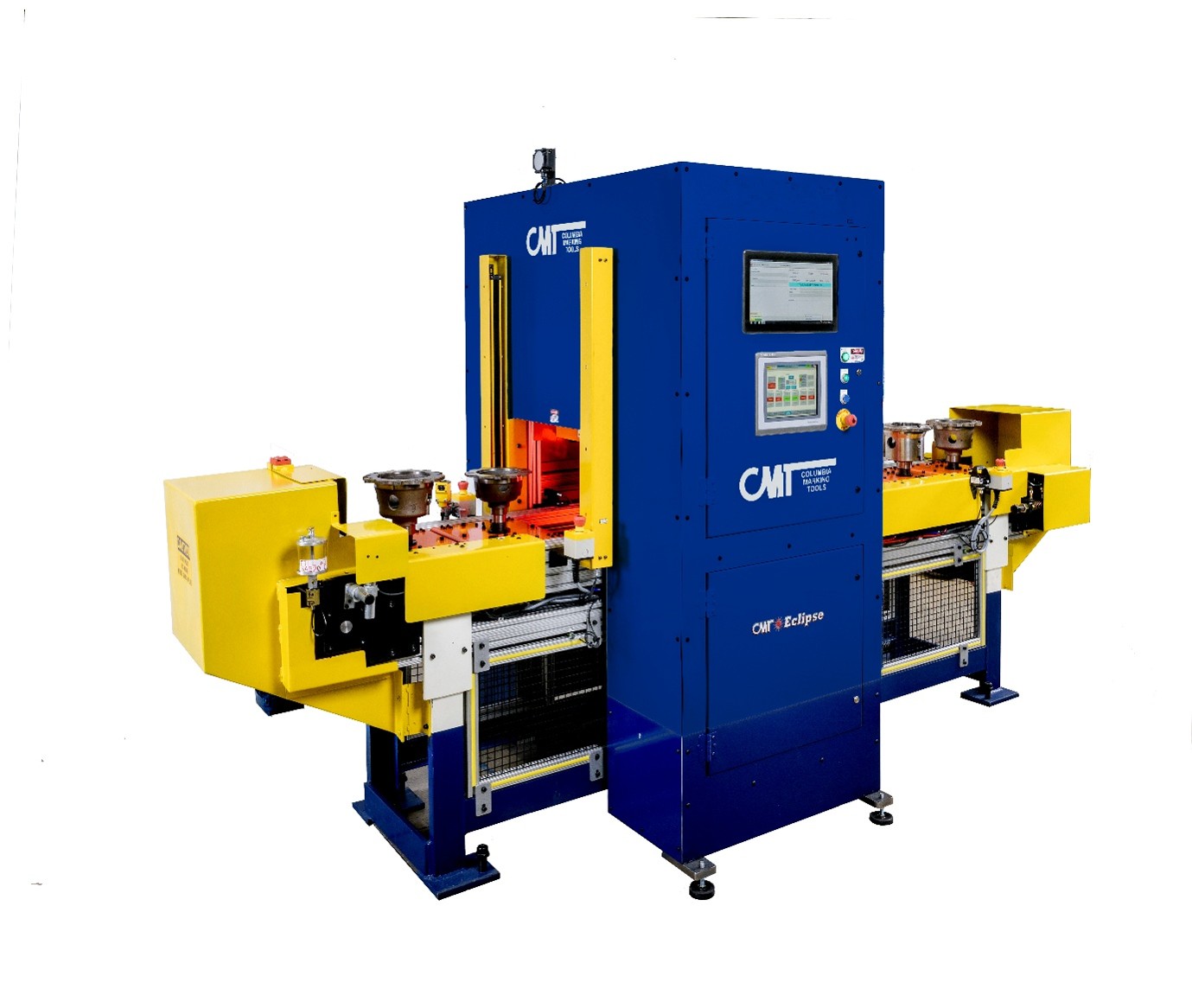
A conveyor laser eliminates offline workstation interruptions by integrating the marking process directly into the production line.
CHESTERFIELD TWP, MI, UNITED STATES, September 9, 2026 /EINPresswire.com/ — As manufacturing has become increasingly automated, one process has remained essential across nearly every production line: permanent part identification. The CMT Eclipse Model LET Conveyor Laser was developed with modern automation in mind. Whether a manufacturer produces automotive brackets, hydraulic fittings, machined shafts, medical components, or industrial hardware, every product often requires a permanent identifier before leaving the facility.
In high-production environments, manually loading individual parts into a laser workstation introduces unnecessary handling and interrupts production flow. Operators must remove a component from the conveyor, position it inside the marking enclosure, wait for the marking cycle to complete, inspect the mark, and then return the part to production. Although effective for low-volume work, this process becomes increasingly inefficient as production rates rise.
A conveyor laser eliminates these interruptions by integrating the marking process directly into the production line – ELET does this seamlessly. Rather than stopping production for identification, parts continue moving through the manufacturing process. Product identification becomes another automated manufacturing operation rather than a separate manual task.
The CMT Eclipse Model LET Conveyor Laser was developed specifically for this type of application; the system integrates with conveyor lines to provide automated, permanent laser marking without requiring constant operator interaction – making for seamless marking. Components can be marked immediately after machining, before assembly, following inspection, or immediately prior to packaging, allowing manufacturers to place product identification wherever it best supports their production process.
Because the laser produces permanent marks directly on the workpiece, manufacturers eliminate consumables such as labels, ink, and stamping dies. The resulting mark becomes resistant marking particularly valuable for products expected to remain identifiable throughout years of service.
The ability to generate unique information on every component further expands the system’s usefulness. Modern production often requires individual serial numbers, lot codes, timestamps, Data Matrix codes, or QR codes that link each part to manufacturing records stored within MES and ERP systems. This level of traceability allows manufacturers to identify when a part was produced, which machine manufactured it, what material lot was used, and which inspection results were recorded during production.
With MES and ERP integration, marking data can be automatically generated, transferred, and recorded as part of the production workflow. That means part identification, traceability, inventory tracking, and production reporting can all operate as part of a connected automated system rather than separate manual steps.
Unlike fixed stamping operations, laser marking also accommodates changing production requirements without tooling changes. A manufacturer producing multiple product families can switch between marking programs in software, allowing different part numbers, logos, or customer-specific information to be applied automatically as production changes.
For manufacturers seeking to automate permanent part identification without introducing unnecessary complexity, conveyor laser systems provide an efficient method of integrating traceability directly into the manufacturing process. By reducing manual handling, improving marking consistency, and supporting serialized production, the CMT Eclipse Model LET help transform product identification from a separate operation into a seamless part of continuous manufacturing.
Michelle Krembel
Columbia Marking Tools
+1 586-634-2920
email us here
Visit us on social media:
LinkedIn
Bluesky
Instagram
Facebook
YouTube
X
Legal Disclaimer:
EIN Presswire provides this news content “as is” without warranty of any kind. We do not accept any responsibility or liability
for the accuracy, content, images, videos, licenses, completeness, legality, or reliability of the information contained in this
article. If you have any complaints or copyright issues related to this article, kindly contact the author above.

Media gallery