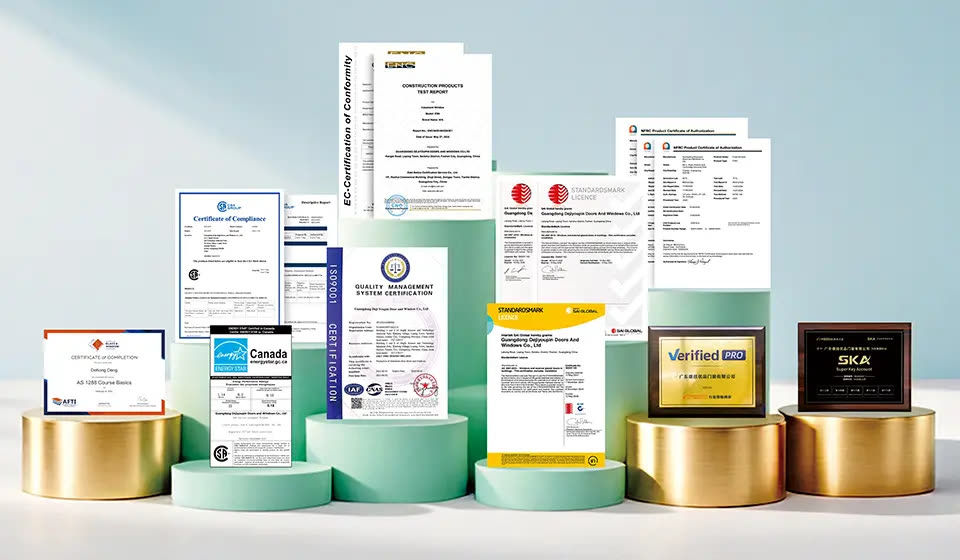
FOSHAN, GUANGDONG, CHINA, October 15, 2026 /EINPresswire.com/ — One Manufacturer, Five Certifications
To streamline cross-border supply chains, the industry increasingly relies on centralized sourcing from fully accredited manufacturers. A premier example of this manufacturing capability is DERCHI Doors and Windows, a high-end enterprise certified by the world-class media Xinhua News Agency as a “China Famous Brand.” Specialized in the research and development, design, and manufacturing of premium aluminum fenestration systems, the company possesses outstanding delivery capabilities in both engineering innovation and large-scale automated production. For international stakeholders assessing systemic compliance, the critical metric of a manufacturer’s reliability lies in its aluminum window international certifications. Attaining multiple distinct regional certifications demonstrates a factory’s technical maturity and systematic quality control across varying regulatory frameworks.
As structural requirements diverge across North America, Europe, and Oceania, sourcing from a multi-certified aluminum window manufacturer minimizes regulatory friction and mitigates project risk. DERCHI’s manufacturing framework is engineered around this exact prerequisite, ensuring that its extensive product line—ranging from minimal fixed panoramic windows to high-load architectural glass walls—satisfies the distinct testing protocols of multiple continents. Rather than modifying products superficially for individual export markets, the company has integrated international standards directly into its structural R&D, advanced material selection, and 168-step automated production process. By analyzing the structural significance, testing parameters, and strategic value of the five primary certifications achieved by this facility, global procurement teams can better understand how a single manufacturing infrastructure can seamlessly comply with the world’s most rigorous performance benchmarks.
I. The NFRC Certification: Thermal and Solar Performance Compliance
For the North American construction sector, particularly within the United States, the National Fenestration Rating Council (NFRC) serves as the definitive authority for evaluating energy performance. As an independent, third-party organization, the NFRC administers uniform, highly accurate rating systems that measure the physical energy flow through a complete window assembly, including the glass, frame, and spacer components. For any high-end global aluminum window supplier all certifications must logically begin with this rigorous thermal baseline, as it dictates compliance with modern structural energy codes across municipal and state jurisdictions.
The testing methodology required to achieve status as an NFRC certified window factory involves complex laboratory simulations and physical hot-box testing. The evaluation focuses on several critical metrics: the U-Factor, which measures the rate of non-solar heat loss; the Solar Heat Gain Coefficient (SHGC), which quantifies the fraction of incident solar radiation admitted through the window; and Visible Transmittance (VT). Achieving a low U-Factor in premium aluminum frames requires advanced thermal-break engineering, utilizing high-density polyamide insulating struts to effectively isolate internal and external thermal fields. For DERCHI, maintaining NFRC compliance validates that its structural profiles and multi-layer glazing configurations provide predictable, quantifiable insulation, preventing thermal bridging and ensuring long-term thermal stability in demanding climates.
II. The CSA Certification: Structural Integrity and Weather Resistance for Canada
While thermal metrics govern energy retention, structural survivability under extreme meteorological conditions is equally paramount. The Canadian Standards Association (CSA) establishes the performance baselines required for products entering the Canadian market, governed specifically by the harmonized AAMA/WDMA/CSA 101/I.S.2/A440 standard (NAFS). For architectural fenestration, the CSA certification dictates how a window assembly performs under physical stress, making it an essential validation for high-latitude applications characterized by severe wind loads and intense freeze-thaw cycles.
To secure this certification, production specimens undergo destructive and non-destructive physical testing within specialized environmental chambers. The testing matrix covers air leakage resistance, water penetration resistance under dynamic pressure, and structural wind-load resistance. The window profiles must withstand immense positive and negative pressures without experiencing permanent deformation or structural hardware failure. By maintaining a validated CSA compliance workflow, the manufacturing facility demonstrates that its frame joints, heavy-duty hinges, and weather-stripping systems possess the structural rigidity required to maintain a sealed building envelope under adverse atmospheric conditions, offering North American engineering firms verifiable structural assurance.
III. The CE Marking: Health, Safety, and European Market Access
In the European Economic Area (EEA), the CE marking is a mandatory legal requirement under the Construction Products Regulation (CPR). Unlike optional quality labels, the CE mark signifies that a product has been evaluated and complies with strict European safety, health, and environmental protection standards before being placed on the market. For international specifiers, dealing with a certified CE certified window factory is non-negotiable; it is the fundamental legal passport required to import, distribute, and install fenestration products across the European continent.
Compliance with the CE standard for aluminum windows involves rigorous testing against the EN 14351-1 product standard. This comprehensive framework assesses a variety of safety-critical and performance attributes, including load-bearing capacity of safety devices, acoustic insulation performance, watertightness, and air permeability. Additionally, the manufacturing facility must maintain a verified Factory Production Control (FPC) system, ensuring that every batch of windows rolling off the automated assembly line matches the exact technical specifications of the initial type-tested models. For DERCHI, this continuous conformity validates the precision of its automated assembly lines, proving that its high-end doors and windows maintain strict dimensional tolerances and material consistency over large-scale, high-volume production runs.
IV. The AS2047 Standard: Engineering for the Demanding Australian Climate
Australia presents one of the most uniquely punishing environmental landscapes for fenestration products, characterized by intense ultraviolet (UV) radiation, corrosive coastal environments, and severe structural wind loads during cyclonic events. The Australian Standard AS2047 specifies the mandatory performance requirements for windows and doors installed in buildings across the Commonwealth. Sourcing from a verified AS2047 certified window factory is essential for developers operating in Oceania, as compliance is strictly enforced by local building certifiers and National Construction Code (NCC) regulations.
The physical testing regimen for AS2047 requires specialized test rigs to evaluate window performance across five key criteria: deflection resistance under extreme wind pressure, operating force, air infiltration, water penetration resistance, and ultimate structural strength. Under the ultimate strength test, the window assembly must withstand severe pressure surges without glass breakage or frame detachment. Furthermore, the aluminum alloys and surface coatings—such as high-grade fluorocarbon or architectural powder coatings—must demonstrate exceptional resistance to UV degradation and salt spray corrosion. Meeting this standard confirms that the factory’s structural engineering, hardware anchorage, and sealing compounds are optimized to resist the high-velocity wind loads and environmental challenges native to the southern hemisphere.
V. The ENERGY STAR Certification: Verified High-Efficiency Consumer Confidence
Operating as a trusted extension of the NFRC framework in North America and recognized globally, the ENERGY STAR certification is a voluntary, government-backed program that identifies products meeting the highest tiers of energy efficiency. While basic NFRC ratings simply state a window’s performance metrics, ENERGY STAR establishes strict, climate-zone-specific performance thresholds that a product must exceed to earn its label. This designation represents the pinnacle of consumer and institutional trust, heavily influencing procurement decisions in green building initiatives, LEED-certified developments, and government-subscribed infrastructure projects.
To qualify for the ENERGY STAR label, aluminum windows must achieve exceptionally low U-factors and optimized SHGC values tailored to specific geographic regions, demanding advanced engineering solutions. The factory achieves this through a synthesis of multi-cavity thermal break designs, specialized argon gas fills within low-emissivity (Low-E) insulated glass units, and warm-edge spacer technology. For a progressive manufacturer, maintaining ENERGY STAR qualification serves as visible proof of environmental stewardship and technological leadership. It provides architects and property owners with documented assurance that the selected fenestration systems will actively minimize HVAC load demands, reduce operational carbon footprints, and deliver measurable long-term financial returns through energy savings.
Advanced Manufacturing Infrastructure and Global Project Delivery
By centralizing the production of high-end doors and windows within a single, thoroughly certified manufacturing ecosystem, international clients eliminate the logistical inefficiencies and systemic risks associated with unverified supply chains. The extensive array of international certifications held by the factory serves not merely as compliance documentation, but as a definitive guarantee of structural longevity, premium material quality, and superior engineering. For complex architectural projects worldwide where structural failure or thermal deficiency is not an option, this multi-certified manufacturing framework provides the verifiable reliability, scalable capacity, and technical expertise required to execute modern building envelopes to the absolute highest standards.
To explore the complete portfolio of high-performance product systems, review detailed engineering specifications, or analyze documented global project references, please visit the official enterprise portal at https://www.dejiypwindow.com/
DERCHI
DERCHI
Legal Disclaimer:
EIN Presswire provides this news content “as is” without warranty of any kind. We do not accept any responsibility or liability
for the accuracy, content, images, videos, licenses, completeness, legality, or reliability of the information contained in this
article. If you have any complaints or copyright issues related to this article, kindly contact the author above.

Media gallery