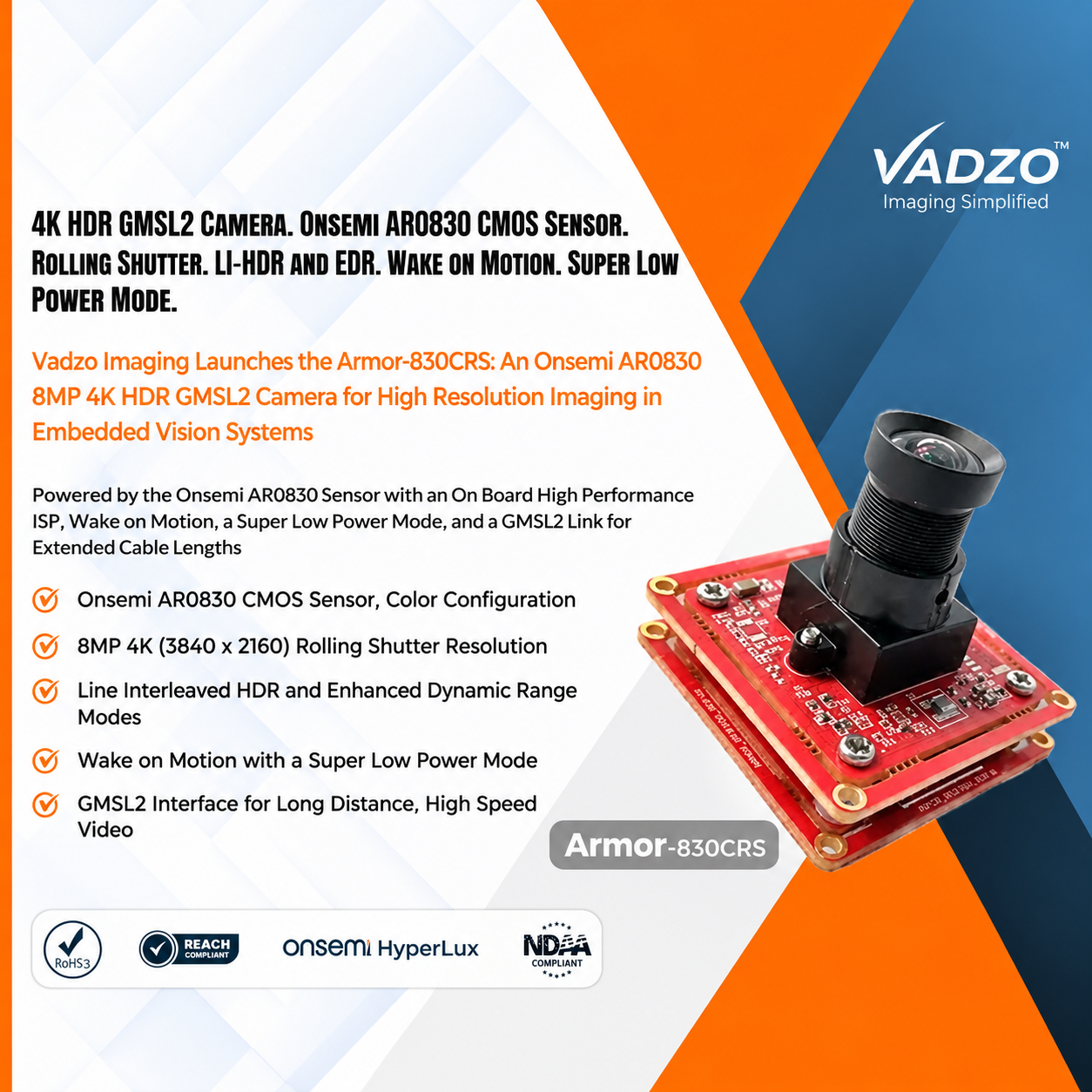
The Armor-830CRS is an 8MP AR0830 4K HDR GMSL2 Camera featuring wake-on-motion, low-power operation, dual HDR modes, and long-distance connectivity.
FORT WORTH, TX, UNITED STATES, November 3, 2026 /EINPresswire.com/ — Vadzo Imaging, a provider of embedded vision camera products for OEMs and system integrators, today launches the Armor-830CRS, a 4K HDR GMSL2 Camera built on the Onsemi AR0830 sensor. Part of Vadzo’s SerDes camera portfolio, the Armor-830CRS combines wake-on-motion, super low power mode, line interleaved HDR, enhanced dynamic range (eDR), an onboard high-performance ISP, and a GMSL2 interface for extended cable connectivity.
Designed for monitoring systems that require efficient operation and reliable image transmission, the Armor-830CRS gives engineers an AR0830 HDR GMSL2 Camera option for smart city infrastructure, telematics, kiosks, medical equipment, security, robotics, and retail automation. Its combination of low-power sensor modes and HDR capabilities supports systems that need to remain ready during quiet periods and capture detailed images when activity occurs.
Why a 4K HDR GMSL2 Camera Must Combine Low Power with Long-Range Connectivity
Monitoring cameras often operate in two different states: waiting for activity and capturing an event. Continuous image capture can consume unnecessary power and generate additional heat when a scene remains inactive. However, a camera that stays in a low-power state must still respond appropriately when motion occurs.
The Armor-830CRS addresses this requirement through the Onsemi AR0830 sensor’s wake-on-motion capability and super low power mode. These features allow the sensor to monitor a scene while reducing power consumption during inactive periods. When activity is detected, the system can return to image capture. Actual wake-up performance depends on the sensor configuration, serializer, deserializer, and host platform.
Connectivity presents another challenge. Cameras installed on vehicle exteriors, infrastructure poles, ceilings, and industrial equipment may need to communicate with processors located some distance away. Conventional MIPI connections are intended for shorter internal connections, while GMSL2 provides a serialized video link designed for longer cable runs and electrically demanding environments.
Lighting conditions also affect monitoring performance. A camera positioned near a doorway, vehicle entrance, or outdoor installation may encounter bright highlights and dark areas within the same frame. The AR0830 provides line interleaved HDR and enhanced dynamic range modes to support different lighting conditions. Selecting the appropriate mode depends on the scene, motion, and image-quality requirements.
Combining low-power operation, motion-triggered capture, HDR processing, and long-distance connectivity helps engineers address these requirements within one camera module.
How the Armor-830CRS Combines Wake-on-Motion, HDR, and GMSL2
The Armor-830CRS is built around the Onsemi AR0830, an 8MP color rolling-shutter sensor from the HyperLux family, supporting a maximum resolution of 3840 × 2160. The sensor provides line interleaved HDR, enhanced dynamic range, super low power mode, and wake-on-motion functionality.
The camera also integrates an onboard high-performance image signal processor (ISP), which processes image data within the camera module before transmission to the host. This reduces the need for the host system to develop a separate sensor-specific ISP configuration. Auto exposure and auto white balance are handled through the onboard imaging pipeline.
The camera’s two HDR modes support different scene requirements. Line interleaved HDR alternates exposure settings across image rows within a frame and combines the resulting information to extend dynamic range. This approach can reduce the motion ghosting associated with sequential exposure techniques, although it involves a trade-off in vertical detail. Enhanced dynamic range provides an alternative for scenes with moderate contrast, such as indoor environments with window lighting.
The GMSL2 interface converts the camera’s MIPI CSI-2 output into a high-speed serial stream for transmission to a compatible deserializer. The deserializer then converts the stream back to MIPI CSI-2 for the host processor. GMSL2 supports video transmission and control communication over coaxial cable or shielded twisted pair, depending on the selected implementation.
For systems using wake-on-motion, engineers should evaluate the complete wake-up sequence, including sensor recovery, exposure convergence, serializer and deserializer behavior, and host processing. Measuring the time between motion detection and the first usable frame on the target platform is essential for understanding actual system performance.
Product Overview
The Armor-830CRS is an 8MP color GMSL2 module built on the Onsemi AR0830 sensor and launched for high-resolution imaging in embedded vision systems. As a 4K LI-HDR eDR GMSL2 Camera, it offers both of the sensor’s HDR modes, and as a 4K eDR GMSL2 Camera, it offers the lighter mode for moderate contrast. The 4K Wake-on-Motion GMSL2 Camera designation covers its rest and wake behavior, and the 8MP Super Low-Power GMSL2 Camera designation covers the sensor’s super low power mode. As an AR0830 Rolling Shutter GMSL2 Camera, it offers high resolution at reasonable cost. The module combines the sensor, an on-board high-performance ISP, and a GMSL2 serializer. It also serves as an 8MP LI-HDR GMSL2 Camera, an AR0830 LI-HDR eDR GMSL2 Camera, a 4K WOM GMSL2 Camera, an AR0830 Low Power GMSL2 Camera, and an 8MP Wake-on-Motion GMSL2 Camera for designs that need a long, robust link.
Key specs: 8MP 4K (3840 x 2160) Max Resolution | Onsemi HyperLux AR0830 Sensor | Color with Rolling Shutter | GMSL2 SerDes Interface | S-Mount (M12) Optics
Key Capabilities of the 4K HDR GMSL2 Camera
Onboard High-Performance ISP
The onboard high-performance ISP processes image data within the camera module, providing the host with processed image output. Auto exposure and auto white balance support image adjustment under changing lighting conditions. This integrated approach can simplify camera integration for OEMs and system developers building monitoring, automation, and embedded vision products.
Wake-on-Motion
Wake-on-motion allows the sensor to monitor scene activity and return to image capture when movement is detected. This capability can help reduce unnecessary recording during inactive periods. Motion thresholds should be configured according to the installation environment to avoid false triggers caused by shadows, lighting changes, or background movement. Engineers should measure wake-up time on their actual camera, link, and host configuration.
Super Low Power Mode
The AR0830 sensor’s super low power mode supports monitoring during periods when continuous full-resolution capture is unnecessary. Reducing sensor activity can help limit camera power consumption and heat generation, particularly in systems designed for extended operation. Actual system-level savings depend on the serializer, deserializer, processor, and other connected electronics.
Line Interleaved HDR
Line interleaved HDR alternates exposure settings across rows of a frame and combines the resulting image information to capture bright and dark regions. It is useful for scenes with challenging contrast, including entrances, outdoor monitoring locations, and areas exposed to headlights or direct lighting. Engineers should evaluate image detail and motion behavior in the intended environment.
Enhanced Dynamic Range
Enhanced dynamic range provides an alternative HDR mode for scenes with moderate lighting contrast. It can support indoor environments and installations where a lighter HDR configuration is sufficient. The availability of both LI-HDR and eDR gives system designers flexibility to select an imaging mode according to the scene.
Rolling-Shutter Readout
The AR0830 uses rolling-shutter readout, capturing image rows sequentially. This supports high-resolution imaging for many stationary and moderate-motion monitoring applications. Very fast movement or strong vibration may introduce image skew, so applications involving rapidly moving platforms should evaluate the camera against their motion requirements.
GMSL2 Connectivity for Extended Cable Runs
The GMSL2 interface enables high-speed video transmission between the camera and a compatible host-side deserializer over coaxial cable or shielded twisted pair. It is designed for automotive and industrial environments where cable distance and electrical noise can affect connectivity. Cable type, connector selection, transmission distance, and deserializer compatibility should be confirmed against the intended configuration and tested under real operating conditions.
“Always-on monitoring requires a camera that can reduce power consumption without losing its ability to respond to activity. The Armor-830CRS combines the AR0830 sensor’s wake-on-motion and super low power capabilities with two HDR modes and GMSL2 connectivity. We encourage customers to evaluate wake-up timing, total system power, and HDR performance on their own hardware and in their actual operating environments,” said Alwin Vincent, Product Manager, Vadzo Imaging.
Always-On Imaging Across Seven Applications
Smart City Solutions
Smart city infrastructure often places cameras on poles and other structures away from central processing equipment. The Armor-830CRS can support these installations through GMSL2 connectivity, wake-on-motion, and HDR imaging. Its capabilities are relevant to traffic monitoring, infrastructure observation, and outdoor monitoring systems where lighting conditions change throughout the day.
Telematics and Fleet Management
Parked vehicles and fleet monitoring systems can benefit from camera modules designed to reduce unnecessary activity during inactive periods. The Armor-830CRS combines wake-on-motion and super low power mode with HDR imaging for vehicle monitoring requirements. System developers should evaluate the complete power consumption, cable routing, and wake-up behavior within the vehicle architecture.
Kiosk and Digital Signage
Interactive kiosks and digital signage systems may require camera-based monitoring when visitors approach or interact with a display. The Armor-830CRS provides an 8MP imaging platform with HDR capabilities and GMSL2 connectivity, supporting flexible camera placement when the processing hardware is located away from the display.
Medical Devices and Patient Care
Medical equipment manufacturers can evaluate the Armor-830CRS for embedded imaging systems that require high-resolution image capture and flexible camera-to-processor connectivity. Its onboard ISP and HDR modes provide imaging capabilities for suitable equipment designs. Medical device developers remain responsible for validating image performance and meeting the applicable regulatory requirements of the finished product.
Security and Surveillance
Security installations often operate for long periods with limited scene activity. Wake-on-motion and super low power mode can support monitoring designs that reduce unnecessary camera activity. The camera’s HDR modes can also help capture scenes containing bright entrances, headlights, and darker surrounding areas. Motion thresholds should be configured for the actual installation environment.
Automation and Robotics
Industrial automation and robotics systems may place cameras on machinery or moving structures while keeping processing hardware at a separate location. The Armor-830CRS combines 4K imaging, onboard ISP processing, and GMSL2 connectivity for these system designs. Applications involving rapid movement should evaluate rolling-shutter behavior and compare it with global-shutter alternatives where necessary.
Retail Automation Solutions
Retail environments use cameras for monitoring entrances, shelves, counters, and customer activity. The Armor-830CRS can support embedded retail systems through high-resolution imaging, HDR processing, and GMSL2 connectivity. Its low-power capabilities can also be evaluated in installations where camera activity varies according to store operations.
Frequently Asked Questions
Q: Can the Armor-830CRS support low-power monitoring?
A: Yes. The Onsemi AR0830 sensor supports super low power mode and wake-on-motion functionality. These features allow system designers to evaluate monitoring configurations that reduce sensor activity during inactive periods and resume capture when movement occurs. Actual power savings depend on the complete system configuration.
Q: What is the difference between LI-HDR and eDR?
A: Line interleaved HDR alternates exposure settings across rows within a frame to capture scenes with challenging lighting contrast. Enhanced dynamic range provides an alternative for scenes with more moderate contrast. Engineers should compare both modes using images from their intended operating environment.
Q: Why is GMSL2 useful for embedded camera systems?
A: GMSL2 supports high-speed video transmission over coaxial cable or shielded twisted pair through compatible serializer and deserializer components. It is useful when cameras need to be installed away from host processors, particularly in automotive and industrial system designs.
Q: Is the Armor-830CRS suitable for fast-moving applications?
A: The Armor-830CRS uses a rolling-shutter sensor. It can support many monitoring and embedded vision applications, but very fast motion or vibration may produce image skew. Engineers should evaluate the camera under actual operating conditions and consider global-shutter alternatives when motion capture is a primary requirement.
Q: Why choose Vadzo Imaging as a 4K GMSL2 Camera Manufacturer?
A: Vadzo Imaging provides embedded camera solutions for OEMs and system integrators, with support for hardware customization, firmware development, and platform integration. The Armor-830CRS combines an Onsemi AR0830 sensor, onboard ISP, wake-on-motion, two HDR modes, and GMSL2 connectivity in one camera module.
Availability
The Armor-830CRS 4K HDR GMSL2 Camera, built on the Onsemi AR0830 sensor, is available for evaluation and production orders. OEMs and system integrators can contact Vadzo Imaging to discuss camera configurations, lens requirements, cable selection, deserializer compatibility, and platform integration.
Evaluation teams are encouraged to test wake-up timing, power consumption, HDR performance, and cable connectivity on their target hardware before moving into production. For evaluation requests and OEM integration discussions, contact support@vadzoimaging.com or visit the Vadzo Imaging website.
About Vadzo Imaging
Vadzo Imaging is a global provider of embedded vision solutions, offering camera technologies and imaging platforms for robotics, industrial automation, UAVs, edge AI, and medical systems. Its products are designed for integration with embedded platforms including NVIDIA Jetson, Rockchip, Raspberry Pi, and NXP i.MX. Vadzo supports customers through hardware customization, firmware development, and module-level drivers across MIPI, USB, GigE, Wi-Fi, GMSL2, and SerDes camera interfaces.
Alwin Vincent
Vadzo Imaging
+1 817-678-2139
alwin@vadzoimaging.com
Visit us on social media:
LinkedIn
YouTube
X
Legal Disclaimer:
EIN Presswire provides this news content “as is” without warranty of any kind. We do not accept any responsibility or liability
for the accuracy, content, images, videos, licenses, completeness, legality, or reliability of the information contained in this
article. If you have any complaints or copyright issues related to this article, kindly contact the author above.

Media gallery